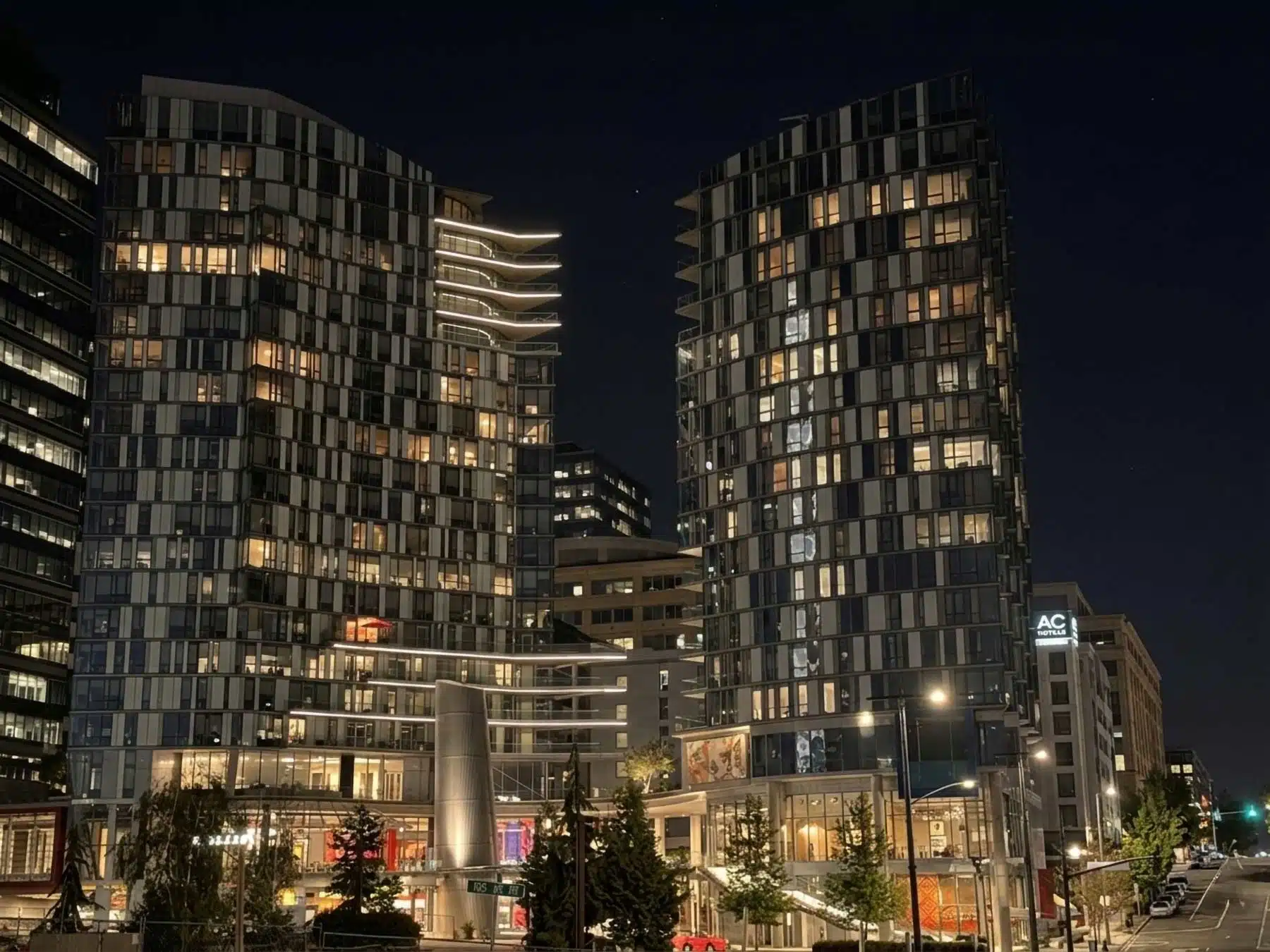
Downtown Bellevue — A Bellevue Neighborhood Guide
By Matthew Konsmo | Coldwell Banker Danforth | Updated May 2026
Living in Downtown Bellevue, WA
Downtown Bellevue is the high-rise heart of the Eastside — a roughly one-square-mile core bounded by I-405 to the east, NE 12th Street to the north, 100th Avenue NE to the west, and Main Street to the south. It’s the densest, most walkable, most transit-connected neighborhood in Bellevue, and it’s the fastest-growing residential area in the city.
The defining shift in the last decade has been vertical. Bellevue has added approximately 3.9 million square feet of new office space since 2021 — more than downtown Seattle over the same period — and Amazon, Microsoft, Meta, Snowflake, OpenAI, T-Mobile, Uber, and Databricks have all expanded their downtown footprints. Residential towers have kept pace: Bellevue Towers, One Lincoln Tower, One88, Avenue Bellevue, Mari, and the under-construction Park Row anchor an inventory that’s grown from a few hundred condo units a generation ago to thousands today.
The second defining shift is transit. The 2 Line light rail opened its Bellevue Downtown Station as part of the East Link segment in April 2024, and on March 28, 2026, the Crosslake Connection completed service across Lake Washington via the I-90 floating bridge — the first light rail in the world to operate on a floating bridge. The Bellevue Downtown Station now connects directly to downtown Seattle in roughly 25–28 minutes, with eight-minute peak headways. Downtown Bellevue is, for the first time, a one-seat train ride from Westlake.
What separates Downtown Bellevue from comparable urban cores is the proximity of green space. Bellevue Downtown Park (21 acres) sits at the southern edge of the high-rises. Meydenbauer Bay Park is a short walk further south to Lake Washington frontage. Old Bellevue — Main Street’s original retail corridor — anchors the southern boundary with a low-rise, boutique-and-restaurant character that pre-dates the towers around it.
Downtown Bellevue Real Estate Overview
Housing stock is overwhelmingly condominium and apartment tower, with a small remnant of low-rise and townhome inventory at the edges. Key inventory bands:
- 1980s–1990s condo towers — Bellevue Pacific Tower (1995) and similar buildings; 20-story scale, original or partially updated interiors, lower price-per-square-foot than newer construction, and HOA financial health that varies meaningfully building to building
- 2006–2008 cycle — One Lincoln Tower (2006), Bellevue Towers (2008, two-building 539-unit complex), Washington Square Towers (2008); larger floor plates, full amenity packages, and the inventory most active in the secondary market
- 2020–2024 luxury cycle — One88 (2020, 147 units), Avenue Bellevue (2023, two-building 332-unit complex), Mari (2024–2025 closings); higher-end finishes, larger amenity programs, and pricing well above the older towers
- Under construction / pre-sale — Park Row by Bosa Development (22 stories, 143 residences along Bellevue Downtown Park, sales opening 2026), plus several other approved mid-rise and high-rise projects in the development pipeline
- Apartment / rental towers — a parallel inventory of purpose-built rentals at every price tier, including buildings that have converted or may convert to condo over time
- Old Bellevue low-rise — small clusters of older two- and three-story buildings on and adjacent to Main Street, some with residential above ground-floor retail
There is effectively no single-family detached inventory inside the Downtown boundary. The detached housing stock starts on the other side of Main Street in Meydenbauer and Enatai, or across NE 12th in West Bellevue.
Downtown Bellevue Home Prices
Downtown Bellevue is one of the most stratified condo markets in Washington. Recent observable bands:
- Studio and one-bedroom in older towers — high $500Ks to low $900Ks
- One-bedroom in newer luxury buildings — approximately $870K to $1.4M
- Two-bedroom mid-range — approximately $1.2M to $1.8M
- Two-bedroom luxury — approximately $1.6M to $2.5M
- Three-bedroom and penthouse inventory — $2.5M to $4M+, with select penthouses transacting above $5M
New construction at Park Row and select Avenue and Mari floor plans push the upper end further. For current pricing, days on market, and inventory by building, see my Western Washington Market Pulse.
Schools in Downtown Bellevue
Downtown Bellevue is served by the Bellevue School District. Elementary assignment varies by specific address — Clyde Hill Elementary, Enatai Elementary, and Medina Elementary all serve portions of the Downtown-adjacent area depending on the building. Middle school assignment generally feeds Chinook or Odle, and high school assignment generally feeds Bellevue High or Interlake High. Always verify the specific elementary, middle, and high school assignment for any given building using the Bellevue School District’s address-lookup tool before relying on schools as a buying factor — Downtown boundaries can split between feeder patterns on the same block.
Private school options within a short drive include Bellevue Christian, Forest Ridge (Bellevue), Overlake School (Redmond), Eastside Catholic (Sammamish), and several Montessori and parochial programs.
The Anchors: What Defines Downtown Bellevue
- The Bellevue Collection — Bellevue Square, Lincoln Square North, Lincoln Square South, and Bellevue Place, the connected retail-hotel-residential complex that anchors the central spine
- Bellevue Downtown Park — 21 acres of formal gardens, a 1,200-foot canal and waterfall promenade, the Inspiration Playground, and the Circle at the park’s center
- Meydenbauer Bay Park — seven acres of Lake Washington waterfront just south of Old Bellevue, with the pedestrian pier, hand-carry boat launch, REI Boathouse kayak and canoe rentals, and the historic whaling building
- Old Bellevue / Main Street — the original 1900s-era retail corridor, now a low-rise boutique and restaurant district connecting Downtown to the waterfront
- The Bravern — luxury retail and the Microsoft Building campus on the east side of Downtown
- Bellevue Arts Museum — at the northeast corner of Bellevue Square
- KidsQuest Children’s Museum — adjacent to the Bellevue Library
- Bellevue Transit Center and the Bellevue Downtown Station — the transit hub at the north end of Downtown, with the 2 Line and a wide network of King County Metro and Sound Transit Express bus service
- Meydenbauer Center — the convention and performing arts center
- The Grand Connection — the planned pedestrian corridor connecting Meydenbauer Bay Park east through Downtown, across I-405, and into Wilburton via the Eastrail
Outdoor Recreation in Downtown Bellevue
- Bellevue Downtown Park — 21 acres, the central canal and waterfall promenade, Inspiration Playground
- Meydenbauer Bay Park — Lake Washington beach, pedestrian pier, kayak and paddleboard rentals, the Bellevue Marina with visitor moorage
- Bellevue Botanical Garden — 53 acres, a short drive east in Wilburton
- Mercer Slough Nature Park — 320 acres of wetland trails immediately south of Downtown via Bellevue Way SE
- The Eastrail and Lake-to-Lake Trail — regional pedestrian-bicycle corridors connecting to the broader park system
- Lake Washington water access — Meydenbauer Bay Park, Chism Beach Park (a short drive south), and Clyde Beach Park (a short drive west)
My Downtown Bellevue Pro Tips: Local Insights for Living, Buying & Selling
1. The 2 Line crosslake opening is still being priced into the market. The Bellevue Downtown Station has been operating since April 2024, but the line only became a true one-seat ride to Seattle on March 28, 2026. For buildings within easy walking distance of the station — generally anything north of Main Street and west of I-405 — the transit utility is meaningfully different than it was even a few months ago. Buyers comparing buildings should think about walk time to the station, not just the building’s amenity package. Pro move: Time the actual walk from the building entrance to the station platform, accounting for elevators and lobby distance. The functional walkshed is more variable than the map suggests.
2. HOA financial health varies dramatically — and matters more than amenities. Downtown Bellevue’s condo inventory spans buildings from the 1980s to current construction. Reserve study quality, special assessment history, recent envelope work, and litigation history vary significantly. A building with a strong reserve fund, recent capital projects completed, and clean meeting minutes is a fundamentally different financial proposition than one with deferred maintenance and pending assessments — even if the units look identical on the listing. Pro move: Always request the resale certificate, reserve study, recent two years of meeting minutes, financial statements, and any special assessment or litigation disclosures before writing an offer. My residential construction background is genuinely useful for reading building envelope condition out of the documents — happy to walk through them together.
3. The Old Bellevue character is protected — but the rest of Downtown is mid-transformation. Old Bellevue / Main Street has a temporary development rules framework that’s been adopted by the city specifically to preserve the low-rise boutique character. The rest of Downtown is on a different trajectory: the Master Development Plan pipeline includes multiple million-square-foot mixed-use projects, and the city’s recent approvals continue to add height and density. Pro move: If view is part of why you’re buying a specific unit, check the city’s Building Bellevue Map for pending and approved development on adjacent parcels. A view that’s clear today may be partially blocked by a project two blocks away in five years.
4. The Meydenbauer Bay Park Phase 2 expansion will reshape the southern edge. The city is moving forward with Phase 2 of the Meydenbauer Bay Park expansion, with construction expected to begin in late 2029. The plan includes removing the apartment buildings at the corner of Main Street and 100th Avenue NE to create a direct pedestrian connection from Downtown to the waterfront, plus the Meydenbauer Gateway pavilion and Lakeside Promenade. Pro move: Buildings along the Main Street / 100th Avenue corridor and along the planned Grand Connection alignment stand to benefit from the long-term walkability investment. Factor the 2029+ timeline into long-hold decisions, not short-hold flips.
5. New construction pre-sale pricing is not the same as resale pricing. Buildings like Park Row, Avenue, and Mari have pricing structures that include developer incentives, rate buydowns, finish allowances, and parking and storage packaging that don’t always translate cleanly to comparable resale value. The first cycle of resale transactions in a new building often establishes a different market level than the original sale prices. Pro move: If you’re buying pre-sale, get clear on what’s included, what’s an add-on, what HOA dues look like at stabilization (not at lease-up), and what your exit looks like if you need to resell within the first three to five years. If you’re buying resale in a building that’s been open for less than five years, expect a learning-curve discount versus original pricing.
6. Parking and storage are pricing factors, not afterthoughts. Downtown Bellevue condo parking ranges from one dedicated space to two or three plus EV charging plus storage. The variance can swing total cost meaningfully. In some older buildings, parking is deeded separately and can be bought, sold, or rented within the building. In newer buildings, parking is typically tied to the unit. Pro move: Confirm exactly how many parking spaces are deeded to the unit, whether EV charging is available or installable, whether the spaces are stacked or standard, and where the storage unit is located. Two side-by-side standard spaces with a large storage cage is a different listing than one tandem space with no storage.
7. Tower microclimates and noise profiles are real. Downtown Bellevue’s high-rise inventory faces different sound and light profiles depending on orientation and elevation. South-facing units above the 15th floor get the Lake Washington and Olympic views. West-facing units get the sunset and Seattle skyline. North-facing units can see Cascade and Mount Baker views on clear days. Lower floors face street noise and surrounding building reflection. Pro move: Tour the unit at the time of day you’d actually use it most. A south-facing unit that’s spectacular at sunset can be hot and glare-prone at midday without proper window treatments. A unit facing NE 8th Street will sound different at 7 a.m. than at 7 p.m.
8. Old Bellevue and Bellevue Way are walkable in a way the rest of the Eastside isn’t. Downtown Bellevue is one of the few neighborhoods on the Eastside where it’s realistic to do most weekly errands on foot. Grocery (QFC on Bellevue Way, PCC in Wilburton via the Eastrail or a short drive), restaurants, coffee, gym, pharmacy, banking, and transit are all genuinely walkable from most Downtown buildings. The free BellHop electric shuttle adds another layer of car-free access. Pro move: If car-free or low-car living is part of why you’re choosing Downtown, walk-test the actual route from the building to your three most-visited weekly destinations. Some buildings sit on better walking grids than others.
9. Resale velocity varies by building, not just by price. Some Downtown buildings have consistent resale velocity, predictable price discovery, and a deep buyer pool. Others trade thinly, with longer days on market and wider price discovery on each transaction. The difference often comes down to building reputation, HOA management, amenity quality, and parking configuration — not just location. Pro move: Pull the building’s three-year transaction history before buying. Average days on market, number of price reductions, and price-per-square-foot trajectory tell you what your exit looks like in five to ten years.
10. Long-term positioning: the employer base keeps growing. Amazon now employs approximately 14,000 people in Bellevue and has publicly discussed reaching 25,000 as the Bellevue 600 campus continues to fill in. OpenAI signed one of the region’s largest AI office leases in February 2026. Meta, Snowflake, Uber, and Databricks have all expanded. The 2 Line opening, the Wilburton redevelopment, and the BelRed corridor’s continued buildout all reinforce Downtown Bellevue as the Eastside’s central employment node. Pro move: For long-hold buyers, Downtown Bellevue is one of the few sub-markets in Washington where the demand drivers continue to expand on a measurable annual basis. The question is less “will this hold value” and more “which building, which floor, which view, and which HOA structure positions best for the next decade.”
Is Downtown Bellevue Right for You?
Downtown tends to fit if:
- You want true walkability — groceries, restaurants, transit, parks all on foot
- You want a one-seat light rail ride to Seattle
- You’re prioritizing access to Eastside employers and want a short or no commute
- You prefer condo living to single-family responsibility — no yard, no roof, no exterior maintenance
- You value amenity packages (pool, gym, lounge, concierge) and centralized building services
- You want urban energy — restaurants, retail, events, the Bellevue Arts Museum, KidsQuest, Snowflake Lane, the Bellevue Jazz Festival, Wintergrass
Downtown may not fit if:
- You want detached single-family living with a yard
- You want to avoid HOA dues, which in newer luxury buildings can run substantial
- You prefer a quieter residential pace — Downtown is built for energy, not seclusion
- You have a budget that caps below the high-$500K entry point for the most accessible studios
- You want a single school district feeder pattern that’s predictable across the neighborhood — Downtown boundaries can split between schools
Surrounding Neighborhoods
- West Bellevue — directly west across 100th Avenue NE, with detached single-family inventory, larger lots, and waterfront frontage on Lake Washington
- Meydenbauer / Enatai — south of Old Bellevue, with established mid-century homes and waterfront pockets
- Wilburton — east across I-405, anchored by the Bellevue Botanical Garden and the Wilburton Station on the 2 Line
- The Spring District / BelRed — northeast of Downtown along the 2 Line, with newer transit-oriented residential and the REI and Meta campuses
- Bridle Trails area — further north toward the Kirkland border, with five-acre equestrian zoning and a fundamentally different housing typology
For the broader city context, see the Bellevue city guide.
Thinking About Buying or Selling in Downtown Bellevue?
I’m a third-generation Western Washington real estate broker with a Fortune 500 advertising background and over a decade of residential construction experience. I work the full Eastside under the NWMLS framework with Coldwell Banker Danforth. Downtown Bellevue condo transactions reward inspection-level fluency with HOA documents, building envelope history, and the development pipeline that’s reshaping adjacent parcels — I bring all three to every transaction.
Matthew Konsmo | Coldwell Banker Danforth
Direct: (425) 463-8243
Email: MatthewKonsmo@gmail.com
Contact me | About Matthew

Matthew Konsmo
Associate Real Estate Broker
Coldwell Banker Danforth
Western Washington
Serving buyers and sellers with integrity and expertise. Matthew is an Associate Real Estate Broker with Coldwell Banker Danforth, helping clients navigate the Pacific Northwest market with confidence.