West of Market
West of Market — A Kirkland Neighborhood Guide
By Matthew Konsmo | Coldwell Banker Danforth Updated May 2026
Living in West of Market, Kirkland
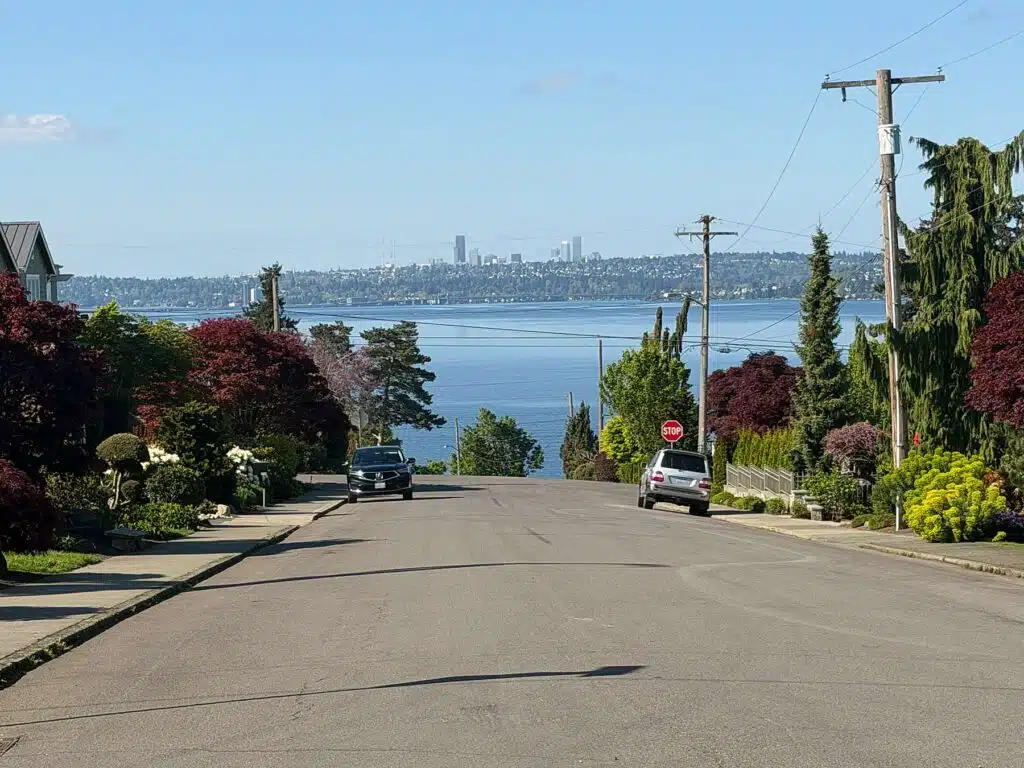
West of Market is one of the most sought after neighborhoods on the Eastside — a residential community of approximately 800 homes situated west of Market Street and north of downtown Kirkland, bordered on the west by Lake Washington and stretching from the downtown waterfront north to Waverly Beach. The neighborhood is defined by three things: lake-and-mountain views, walkable proximity to downtown Kirkland’s waterfront, dining, and shopping district, and one of the most active teardown-rebuild markets anywhere in Western Washington.
The neighborhood’s geographic position is exceptional. West of Market sits directly on Lake Washington’s eastern shore, with multiple waterfront homes along Lake Avenue and stunning westward views toward Seattle, the Olympic Mountains, Mount Rainier, and the lake itself. Downtown Kirkland is a 5-10 minute walk from much of the neighborhood. Microsoft’s main Redmond campus is approximately 10-15 minutes east. Downtown Bellevue is roughly 10-15 minutes south. Downtown Seattle is approximately 25-30 minutes off-peak via I-405 and SR-520 (longer in rush hour).
West of Market has an unusual character among Eastside neighborhoods because it’s both established and continuously transforming. The neighborhood was largely built out between the 1920s and 1970s, with substantial original housing stock from the early-to-mid twentieth century. But beginning roughly in the early 2000s and accelerating significantly over the past decade, West of Market has seen one of the highest concentrations of teardown-rebuild and major-remodel activity anywhere on the Eastside. Notable local builders including Enfort Homes, BDR Fine Homes, Prestigious Builds, Gerry Homes, and others have produced extensive new-construction inventory throughout the neighborhood, particularly on streets with view potential.
West of Market Real Estate Overview
West of Market has an unusually wide housing-stock mix because of the layered eras of construction and the active redevelopment. The detached single-family core spans roughly a century of construction, from original 1920s craftsman homes through 1950s-60s mid-century, 1970s-80s tract construction, and the substantial 2010s-2020s new-construction wave that’s reshaped the neighborhood.
Architectural styles you’ll encounter throughout West of Market include:
- Original 1920s-1940s craftsman bungalows — increasingly rare as teardown-rebuild activity has reduced the original inventory, but still present on some interior streets
- Mid-century ranchers and split-levels — common throughout the residential interior
- 1970s-80s tract homes — two-story floor plans with attached garages
- Northwest Contemporary new construction — the dominant style of recent rebuilds, with volume, light, large windows, and seamless indoor-outdoor living
- Hamptons-inspired and craftsman-style new construction — high-end custom builds with distinctive architectural detailing
- Cottage-style new construction — smaller-footprint contemporary homes designed for the neighborhood’s tighter lot sizes
- Townhomes — limited inventory, primarily near the Market Street and downtown edges
- Waterfront estates — homes along Lake Avenue with private docks, boat lifts, and direct Lake Washington shoreline access (rare and high-demand)
- ADU-included properties — increasingly common with new construction, including detached ADUs above garages and attached units with separate entrances
The neighborhood’s teardown-rebuild dynamic is genuinely unusual. In a typical year, dozens of West of Market properties trade as teardown candidates or come back to market as completed new construction. This affects both buyer and seller strategy in ways that don’t apply to most Eastside neighborhoods.
West of Market Home Prices
West of Market has the widest absolute price range of almost any Eastside residential neighborhood. Recent activity has spanned from townhomes in the high-$700K range, original-condition single-family homes typically starting around $1.5M, well-located non-view homes in the $2M-$3M range, view-oriented hillside homes in the $3M-$5M range, and waterfront properties on Lake Avenue regularly listing in the $5M-$15M+ range depending on shoreline length, dock features, and home condition.
For current Kirkland and West of Market market data, see the Kirkland Real Estate Market Pulse.
Schools in West of Market
West of Market is served by the Lake Washington School District — one of Washington’s most consistently high-performing public school districts. School assignments within West of Market typically include:
- Peter Kirk Elementary
- Kirkland Middle School
- Lake Washington High School
Lake Washington School District periodically redraws boundaries, so buyers should verify current school assignment with the district directly using their address-lookup tool at lwsd.org before making decisions based on school assignment.
The Anchors: Lake Washington, Waverly Beach, Downtown Kirkland
West of Market’s identity is built around three major anchors:
Lake Washington and the Kirkland waterfront — The neighborhood’s western edge is Lake Washington itself. Lake Avenue runs along the shoreline and includes the most coveted waterfront addresses on the Eastside outside of Medina, Hunts Point, and Yarrow Point. Multiple Lake Avenue properties have private docks, boat lifts, and direct lake access. The Kirkland Homeport Marina sits at the southern edge of the neighborhood near downtown, providing public moorage and waterfront connection.
Waverly Beach Park — The neighborhood’s northern waterfront anchor. A 4.5-acre lakefront park with sandy beach, swimming, picnic areas, playground, restrooms, and seasonal lifeguard service. Walking distance from much of West of Market and one of the most popular family beaches on the Eastside.
Downtown Kirkland — Directly south of West of Market across Market Street. Downtown’s restaurants, shops, the Kirkland waterfront promenade, Marina Park, and the seasonal Kirkland Wednesday Market are all within walking distance from much of the neighborhood. The Cross Kirkland Corridor (now Eastrail) trail begins in downtown Kirkland and connects to Bellevue, Renton, Woodinville, and beyond.
The combination of waterfront access plus walkable downtown plus established residential character is genuinely difficult to replicate elsewhere on the Eastside. Most Eastside waterfront neighborhoods (Medina, Hunts Point, Yarrow Point) are exclusively residential with no walkable downtown. Most walkable downtowns (Redmond Town Center, Crossroads Bellevue) don’t have direct waterfront residential adjacency. West of Market is one of the few neighborhoods that combines all three.
Outdoor Recreation in West of Market
Beyond Waverly Beach Park and Lake Washington, West of Market has strong outdoor amenity access:
- Heritage Park — historic park with views of Lake Washington and downtown Kirkland
- Marina Park — downtown Kirkland’s central waterfront park with the Kirkland Homeport Marina, beach, and event lawn
- Cross Kirkland Corridor / Eastrail — direct connections from downtown Kirkland to a 40+ mile regional non-motorized corridor connecting Renton, Bellevue, Kirkland, Woodinville, and (eventually) other Eastside communities
- David Brink Park — small waterfront park and beach access
- Houghton Beach Park — south of downtown Kirkland but easily accessible
For longer outdoor pursuits, West of Market’s I-405 access puts you within roughly 35-40 minutes of Snoqualmie Pass skiing in winter and 25-30 minutes of North Bend / Rattlesnake Ridge hiking year-round.
Surrounding Neighborhoods
- Downtown Kirkland to the south — across Market Street, with restaurants, shops, the waterfront promenade
- Norkirk to the east — established neighborhood north and east of downtown Kirkland
- East of Market — directly east, with newer construction and similar lot sizes but different view dynamics
- Houghton to the south — south of downtown Kirkland, established residential area
- Juanita to the north — past Waverly Beach Park, with Juanita Beach Park and a different commercial center
My West of Market Pro Tips: Local Insights for Living, Buying & Selling
West of Market has more variables than most Eastside neighborhoods because of the active teardown-rebuild market, the dramatic view-vs-non-view price spread, the waterfront tier, and the layered eras of construction. Here’s what I tell clients before they tour homes here.
1. The View Tier Determines Everything
This is the single most important West of Market tip. The neighborhood has fundamentally different price tiers based on view quality, and understanding which tier a home is in changes both pricing analysis and resale strategy:
- Waterfront (Lake Avenue and immediately adjacent streets with direct lake access): the highest tier, with private docks, boat lifts, and shoreline. Price floor typically $5M+
- Direct lake view (homes positioned to see Lake Washington from main living areas): substantial premium over non-view homes
- Filtered or partial view (some lake or mountain visibility, often through trees or between neighbors): meaningful but smaller premium
- Non-view (interior streets without significant lake or mountain visibility): the entry point to the neighborhood
The price spread between non-view and direct-view homes can be $1M-$3M for otherwise similar properties. Buyers who don’t carefully evaluate view quality can substantially overpay or underpay depending on what they’re optimizing for.
Pro move: When evaluating a West of Market home, walk the property at multiple times of day to actually verify the view claim. Listing photos can be misleading, particularly for “filtered” or “partial” view homes where seasonal foliage substantially affects visibility. Check the view in winter (when trees are bare) and summer (when foliage is full) — they can be dramatically different.
2. The Teardown-Rebuild Market Is Real and Affects Strategy
West of Market has one of the highest concentrations of teardown-rebuild activity on the Eastside. This affects buyer and seller strategy in several specific ways:
- For buyers of original-condition homes: you may be competing against builders looking to tear down. This can compress original-condition inventory and drive prices up
- For sellers of original-condition homes: evaluate whether to sell as-is to a builder or invest in cosmetic updates. Builder offers can sometimes be competitive but typically come with different terms
- For buyers of new construction: there’s substantial new-construction inventory from named local builders. Quality varies — some builders are well-regarded, others less so
- For long-term holders: properties on streets seeing active rebuilding may have construction-period disruption affecting daily life
- For lot value calculations: in some West of Market locations, the lot is worth more than the existing improvements, which fundamentally changes pricing analysis
Pro move: When evaluating any West of Market property, get a clear understanding of the lot value separately from the home value. For original-condition homes, ask yourself whether you’d want to live in the existing home, remodel it, or tear it down — and price accordingly. My residential construction background helps significantly here when running cost-to-value analysis on remodel-vs-rebuild scenarios.
3. Walkability to Downtown Kirkland Varies Dramatically
The “walkable to downtown Kirkland” claim is technically true for most of West of Market, but the actual walking experience varies substantially:
- 5-minute walk: southern West of Market streets within 2-3 blocks of Market Street and Central Way
- 10-minute walk: most of central West of Market with reasonable topography
- 15-20 minute walk: northern West of Market and uphill streets
- Driving from northern West of Market is typically the realistic option even though “downtown is close”
The topography matters significantly. West of Market sits on the slopes leading down to Lake Washington, and walking back uphill from the waterfront on a hot summer day is a different experience than walking down to dinner on a cool spring evening.
Pro move: Walk the actual route from any home you’re considering to the specific downtown Kirkland destinations you’d actually use (your favorite restaurant, the grocery store, the waterfront). Test it both directions — downhill walks back uphill, and the full route varies more than buyers expect.
4. The Original Construction Era Inspection Realities
A meaningful share of West of Market original-condition homes were built between 1920 and 1975. That layered era of Pacific Northwest construction has predictable inspection findings — and the issues vary by construction era:
For 1920s-1940s craftsman homes:
- Knob-and-tube wiring — common in pre-1950s homes; flagged by most insurance carriers and often requires substantial replacement
- Cloth-wrapped wiring — degrades over time
- Foundation issues — original poured concrete or stone foundations may have settling or moisture issues
- Lead paint — required disclosure for pre-1978 homes; remediation required for renovations
- Lead and galvanized water lines — common in original construction
For 1950s-1970s homes:
- Galvanized water supply lines — common before ~1965
- Cast iron drain lines — durable but eventually fail at joints
- Original electrical panels — Federal Pacific (FPE) and Zinsco panels are flagged by most insurance carriers
- Single-pane windows — common in original homes
- Cedar shake or composition roofs at end of life
- Older oil tanks — some homes were originally oil-heat; buried tank decommissioning matters for both insurance and environmental clearance
- Asbestos in popcorn ceilings, vermiculite insulation, or original floor tile — testing is inexpensive and worth doing before any remodel
Pro move: Get a thorough inspection that includes a sewer scope, request permit history from the City of Kirkland’s online portal, and test for lead paint and asbestos before removing the inspection contingency. The inspection cost on an older West of Market home is often higher than typical because of the construction-era complexity, and it’s money well spent.
5. Waterfront Properties Are a Different Market
Lake Avenue and adjacent waterfront properties trade in fundamentally different dynamics than the rest of West of Market. Worth knowing:
- Limited inventory — there are only so many waterfront parcels. Premium properties may not come to market for years at a time
- Price discovery — comp analysis is harder because of low transaction volume; pricing is more reliant on individual property characteristics (shoreline length, dock features, home condition, view quality)
- Dock and shoreline regulations — Washington State Department of Ecology and the City of Kirkland regulate over-water structures, dock modifications, and shoreline alterations. This affects what can be added or modified
- Insurance considerations — waterfront properties have different insurance dynamics than non-waterfront, including potential flood and shoreline-erosion considerations
- Environmental considerations — wetland buffers, riparian setbacks, and critical area regulations apply to some waterfront parcels
Pro move: If you’re considering Lake Avenue or other waterfront West of Market properties, build extra inspection and due diligence time into your offer terms. Dock condition, shoreline stability, and over-water structure permits all warrant verification. The waterfront premium is real and earned, but the additional complexity warrants expertise.
6. The ADU Reality
The City of Kirkland has been progressive on accessory dwelling unit (ADU) regulations, and ADUs are increasingly common in West of Market new construction. ADUs can be attached (with separate entrances) or detached (typically above garages or as separate small-footprint structures).
For buyers, ADUs offer:
- Multigenerational living — separate space for parents, adult children, or extended family
- Rental income potential — long-term or short-term rental options (subject to City of Kirkland rules)
- Home office or studio space — flexible use as the household needs change
- Resale value premium — ADU-included properties typically command higher prices
For sellers and renovators, the City of Kirkland’s ADU rules are generally permissive but have specific requirements for parking, owner-occupancy in some scenarios, and design standards.
Pro move: If ADU potential matters for your purchase strategy, verify the specific property’s ADU status (existing or potential to add) with the City of Kirkland during due diligence. Lot size, zoning, and existing structures all affect what’s possible.
7. Downtown Kirkland Adjacency: Asset and Variable
West of Market’s adjacency to downtown Kirkland is one of its strongest assets — but downtown’s seasonal activity creates some variables worth knowing:
- Summer weekends are extremely active in downtown Kirkland, with substantial foot traffic, restaurant crowds, and event programming. Homes in southern West of Market closest to Market Street may experience some downtown-adjacent activity
- Kirkland Wednesday Market (seasonal, summer through fall) brings additional activity to the downtown waterfront
- Concerts at Marina Park during summer months bring evening activity
- Independence Day fireworks at Marina Park draw crowds and traffic to downtown
- Most northern West of Market is far enough from downtown to be unaffected by these seasonal dynamics
For buyers, this is generally a feature — proximity to a vibrant, walkable downtown is part of why West of Market commands a premium. But buyers who want very quiet residential character with no downtown adjacency may prefer northern West of Market or other Eastside neighborhoods.
Pro move: Visit West of Market on a busy summer Saturday — particularly during Wednesday Market or a downtown event — to understand the seasonal activity dynamic before committing.
8. The Long-Term Eastside Position
West of Market sits at an unusually privileged position in the broader Eastside transformation:
- Direct waterfront access on Lake Washington with high barriers to entry — limited inventory, high demand
- Walkable downtown Kirkland — one of the few genuinely walkable downtowns on the Eastside
- Cross Kirkland Corridor / Eastrail — direct connection to a major regional non-motorized corridor
- Sound Transit Stride bus rapid transit (planned) — connecting Kirkland to the broader transit network
- Top-tier school district — Lake Washington School District performance attracts long-term family buyers
- Active teardown-rebuild market — continuously refreshing the housing stock and providing new construction options
For long-term holds, West of Market’s combination of waterfront access, walkability, and continuous reinvestment is genuinely difficult to replicate. The neighborhood has been a top-tier Eastside destination for decades and shows no signs of changing position.
Pro move: When evaluating West of Market for a long-term hold, focus on the durable features — view, lot quality, walkability to downtown, school assignment — rather than current home condition. Homes can be remodeled or rebuilt; lot characteristics generally cannot.
Is West of Market Right for You?
West of Market tends to be a strong fit when:
- Walkability to a vibrant downtown is a priority
- Lake Washington access — whether direct waterfront, view, or short-walk to Waverly Beach — matters to you
- Lake Washington School District schools are a priority
- You appreciate a neighborhood with both established character and active investment
- You’re comfortable with construction-period activity from ongoing teardown-rebuild work
- You want a location that combines residential character with adjacency to dining, shopping, and waterfront amenities
It may be less of a fit when:
- You want very quiet residential character without seasonal downtown activity
- Larger lots and more rural character are priorities — West of Market lots are tighter than typical Eastside large-lot neighborhoods
- The price tier required for view properties exceeds your budget — non-view West of Market is often comparable in price to view homes elsewhere on the Eastside
- You don’t expect to use Lake Washington access and don’t value the walkable downtown — you may get more home for less money in less-premium Eastside neighborhoods
Thinking About Buying or Selling in West of Market?
West of Market is one of the most genuinely exceptional Eastside neighborhoods to walk buyers and sellers through because of the layered complexity — waterfront vs. non-view tiers, original-vs-new-construction dynamics, the active teardown-rebuild market, the dramatic price spread within the neighborhood. The right strategy depends entirely on which version of West of Market you’re targeting and your specific goals.
If you’re considering West of Market — whether buying a waterfront estate, an original cottage on a non-view street with rebuild potential, or a new-construction home from one of the active local builders — let’s talk. I can pull recent comps, walk you through what’s coming to market, and help you think through whether West of Market fits your priorities better than alternatives like East of Market, Houghton, or other premium Eastside locations.
Direct: (425) 463-8243 Email: MatthewKonsmo@gmail.com Schedule a Consultation →
Working With Matthew
I love touring homes in the West of Market neighborhood. There are some fantastic remodeled homes and waterfront homes. The area is light and bright with lots of natural light, and the views of Lake Washington are beautiful. Deru for lunch and Zoka coffee are just down the street—a few local staples in my diet.

Matthew Konsmo
Associate Real Estate Broker
Coldwell Banker Danforth
Western Washington
Serving buyers and sellers with integrity and expertise. Matthew is an Associate Real Estate Broker with Coldwell Banker Danforth, helping clients navigate the Pacific Northwest market with confidence.